
Bursting discs for dependable pressure relief
Specify the disc, holder and indication around the real duty—not a catalogue description. Assentech supplies industrial bursting-disc solutions for pressure and vacuum protection, with UK support for sizing, site surveys, installation and urgent replacement requirements.
- Broad metallic, hygienic, graphite and specialist range
- Application-led selection and documentation support
- UK-based specification, site and lifecycle support
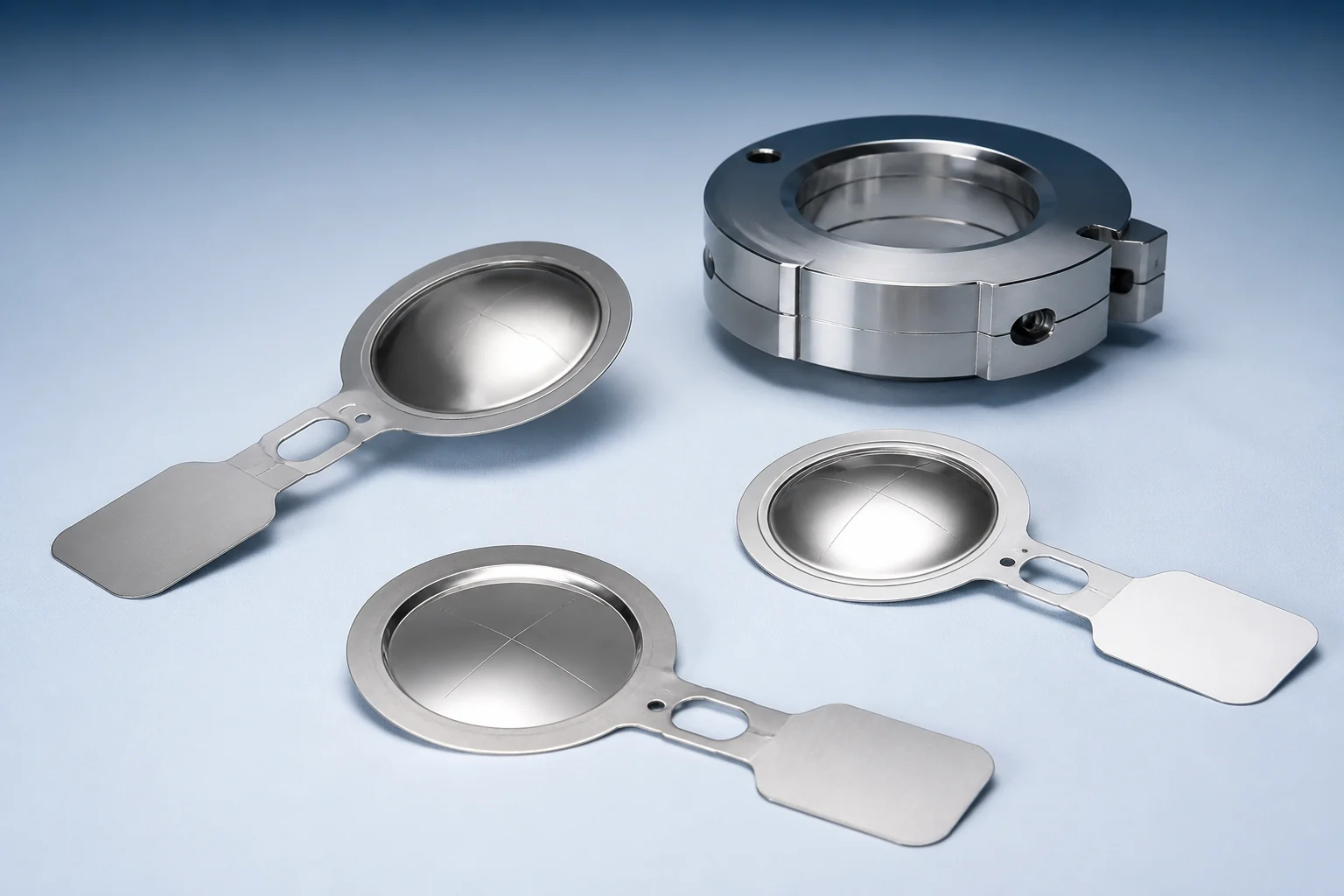
Start with the pressure-relief duty
A bursting disc—also called a rupture disc—is a non-reclosing pressure-relief device. Its pressure-sensitive element is designed to open at a specified differential pressure and temperature. Once it has operated, it must be replaced before the protected system returns to service.
Process conditions
Identify the process medium, phase, normal and relieving temperature, corrosion concerns and any hygienic or contamination-control requirement.
Pressure relationship
Record maximum allowable working pressure, normal operating pressure, required burst pressure, tolerance, back pressure and vacuum conditions.
Service behaviour
Explain whether pressure is static, cyclic or pulsating, how quickly the upset can develop, and whether liquid, gas/vapour or two-phase relief is credible.
Installation and relief path
Confirm line size, connection, holder, flange details, inlet and discharge arrangement, vent destination, available space and indication requirement.
Where bursting discs fit in a pressure-relief strategy
Bursting discs can perform several roles, but the arrangement must be selected and sized as a system by competent people.
Primary pressure relief
The disc provides the relieving opening for a defined overpressure or vacuum scenario. The downstream consequences and safe discharge route must be considered.
Relief-valve isolation
An upstream disc can isolate a valve from corrosive, viscous or polymerising media. The combination has specific sizing, monitoring and fragmentation requirements.
Secondary protection
A disc may form part of a wider protection strategy. Set pressures, capacities and discharge routes must be coordinated across the devices.
Vacuum and back pressure
Some designs address vacuum or reverse differential pressure. Capability is product- and application-specific; never infer it from appearance.
Bursting-disc product families
Assentech supports a broad industrial product range while remaining your single UK point of contact. The names below identify product families, not a substitute for a verified application review.
Premium reverse-acting families
- AtlasFor demanding industrial duties, including applications requiring larger sizes or higher burst pressures.
- AxiusA versatile reverse-acting family for challenging process duties and a range of material requirements.
- Ultra Low PressureMetallic reverse-acting solutions for selected low-pressure gas or vapour duties and pressure-sensitive equipment.
Standard forward-acting families
- Poly-SD and SCRDForward-acting options spanning conventional and specialist duties.
- HOVA forward-acting family considered against pressure, temperature, phase and installation requirements.
- AD Series and P SeriesAdditional families for duties where their construction and mounting suit the application.
Hygienic families
- Axius SCReverse-acting hygienic design for clean process duties.
- Ultra Low Pressure SCHygienic option for selected low-pressure gas or vapour applications.
- SHX and SR-HFurther hygienic families for duties requiring different pressure or design characteristics.
Graphite and specialist families
- Graphite SeriesFor selected low-pressure, corrosive or temperature duties where graphite is appropriate.
- Custom-engineeredFor applications that need modification or engineering beyond a standard assembly.
- ExtruderSpecialist devices for pressure protection on plastics-processing machinery and related mounting arrangements.
Complete assembly: holders, insert or pre-torqueable arrangements, burst indication and other accessories are specified with the disc. Availability, materials, approvals and performance depend on the selected family, size, burst condition and order.
Choosing the right bursting-disc category
No category is automatically “best”. The correct choice satisfies the protected equipment, credible relief case, process conditions, required capacity, installation and conformity route.
| Category | How it acts | Often considered when | Confirm before selection |
|---|---|---|---|
| Reverse-acting | The dome reverses before its engineered opening feature activates. | Cycling, close operating relationships or vacuum/back-pressure performance matter. | Phase, available free volume, pressure basis and family-specific limits. |
| Forward-acting | Tensile loading causes the element or opening feature to activate. | A broad material, temperature, pressure or specialist mounting range is needed. | Operating ratio, fatigue behaviour, vacuum support and fragmentation. |
| Hygienic | Forward- or reverse-acting construction configured for clean-process duties. | Product-contact geometry, cleanability and hygienic connections are critical. | Gaskets, connection, cleaning/sterilisation cycle, packaging and documentation. |
| Graphite or specialist | Material and mounting are engineered around non-standard service needs. | Corrosion, low pressure, temperature or machinery geometry drives the duty. | Handling, holder/mounting, downstream effects and exact process conditions. |
Applications across critical industries
Each sector changes the questions engineers need to answer. The points below are selection prompts—not generic suitability claims.
Reactive and corrosive duties
Material compatibility, reaction scenarios, fouling, polymerisation, cycling and safe handling of the relieved medium can govern the design.
Clean and traceable systems
Hygienic connections, cleanability, sterilisation cycles, batch protection and documented materials may be central to the specification.
Product-contact considerations
Product-contact geometry, cleaning regimes, gasket materials and contamination control often sit alongside pressure-relief performance.
Leakage and material review
Leakage control, material selection, holder materials, cycling, vent routing and interaction with pressure-relief valves need assessment.
Demanding pressure systems
Corrosion, sour or mixed service, high or changing temperatures, back pressure and discharge-system design may drive the selection.
Relief case and destination
Allowable pressure, required capacity, fire or vacuum cases, device location and the destination of any release must be considered together.
Treat the relief path as one connected system
A correctly specified disc cannot compensate for an undersized inlet, obstructed discharge or unsuitable vent destination. The protected equipment, nozzle, holder, disc, downstream pipework and disposal system all influence the result.
UK support from specification to replacement
Assentech helps turn plant information into a focused next step, from a new duty to an urgent replacement requirement.
Assentech combines established pressure-relief technology and documentation with a local, application-led point of contact.
Standards, conformity and order documentation
ISO 4126-2 specifies requirements for bursting-disc safety devices. Applicable conformity marking and documentation depend on the product, configuration, destination market and order.
For Great Britain, current government guidance recognises both CE and UKCA routes for relevant pressure equipment. Northern Ireland and other markets have different requirements; do not assume one approval covers every destination.
Useful references: HSE relief-system guidance, the ISO 4126-2 overview and Great Britain pressure-equipment guidance.
Agree the document pack before ordering
- Declaration of conformity or product certificate appropriate to the order
- Lot and burst-test documentation where supplied
- Material certification where specified
- Identification and traceability information
- Current installation and maintenance instructions
- Burst-indicator or hazardous-area documentation where applicable
Questions engineers and operators ask
Need advice for a live duty? Share the process data and existing tag details with Assentech.
Is a bursting disc the same as a rupture disc?
Yes. In industrial pressure relief, the terms are normally synonymous. “Bursting disc” is common British usage; “rupture disc” or “rupture disk” is also widely used internationally.
Is a bursting disc reusable after it opens?
No. It is a non-reclosing, single-use device. After operation, make the process safe, investigate the cause and install a correctly specified new disc before restart.
What information is needed to specify a bursting disc?
Provide the protected equipment and allowable pressure, operating and burst conditions, disc temperature, medium and phase, relief case and capacity, vacuum/back pressure, cycling, materials, connection and holder, discharge arrangement, codes, marking and documentation requirements.
Should I choose a forward-acting or reverse-acting disc?
That depends on pressure relationship, phase, cycling, vacuum/back pressure, free volume, material, size and required opening behaviour. An application review is safer than selecting by category alone.
Can a bursting disc be installed with a pressure-relief valve?
Yes, in a properly engineered arrangement. Capacity, spacing, interspace monitoring, fragmentation behaviour and applicable code requirements must be checked.
Can bursting discs protect against vacuum?
Some devices and assemblies are designed for vacuum or reverse differential-pressure duties. Confirm the exact capability for the family, material, size, holder and installation.
How often should a bursting disc be replaced?
There is no safe universal interval. Use manufacturer guidance, process severity, corrosion, cycling, temperature history, shutdown opportunities, inspection findings and site risk assessment.
What documentation should arrive with a bursting disc?
The pack depends on the order and market. Agree it before purchase. It may include conformity declarations, product or lot certificates, material records, traceability information and current installation and maintenance instructions.
Choose the guide that matches your task
Discuss your bursting-disc duty
Send the process medium, pressure and temperature data, relief case, existing tag or holder details and any time constraint. Assentech will help define the next technical step.