
Bursting disc selection and sizing guide
A bursting disc cannot be selected safely from pressure and pipe size alone. The protected equipment, credible relief case, required capacity, fluid behaviour, operating margin, temperature, back pressure, installation and conformity route all matter.
Scope: use this guide to prepare a technically useful enquiry. It explains the inputs; it is not a substitute for a documented relief calculation or competent engineering review.
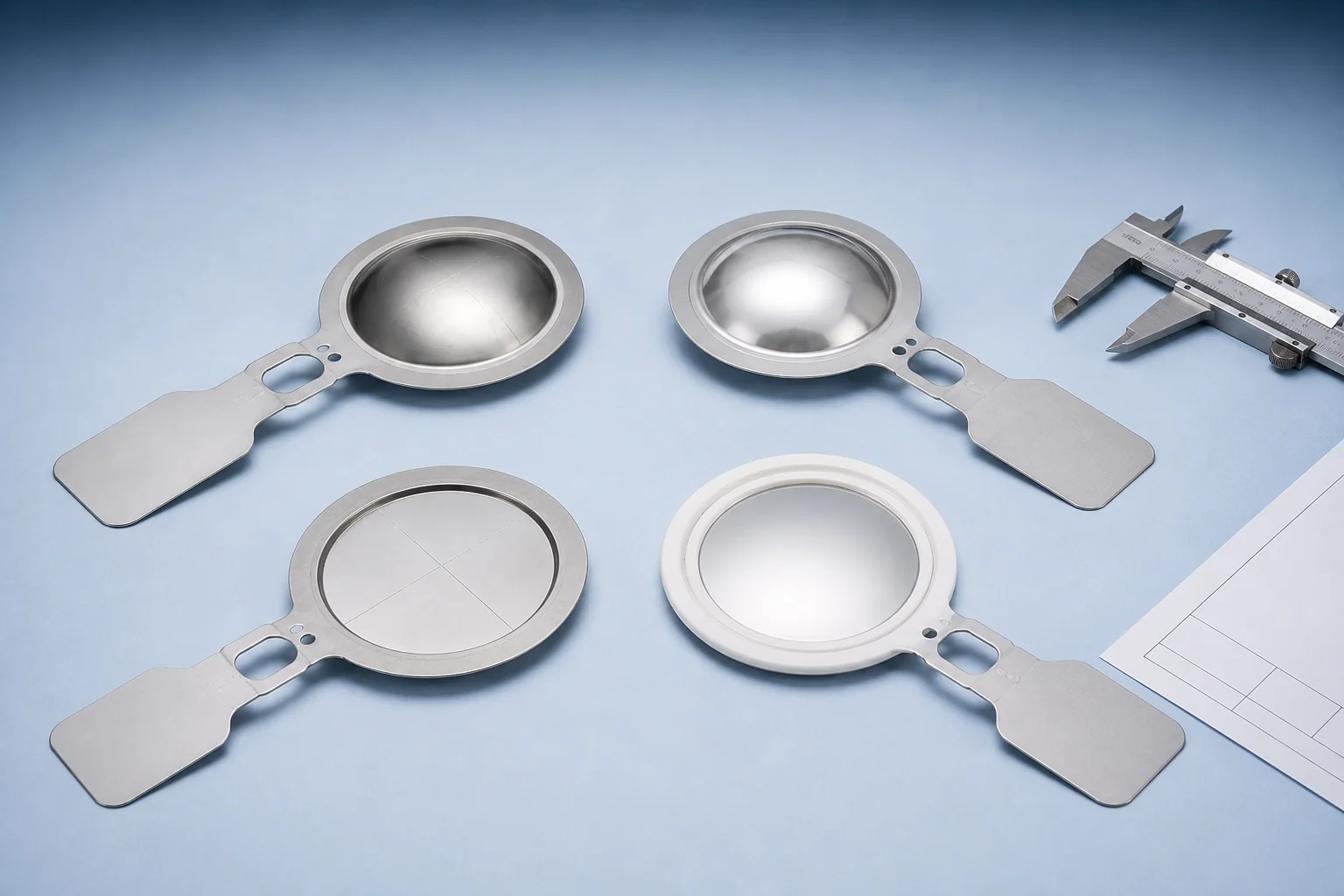
Selection starts with the whole relief system
The bursting disc is one component in a path that begins at the protected equipment and ends at a safe discharge or disposal location. An appropriate disc cannot correct an obstructed inlet, undersized outlet, excessive back pressure or unsuitable destination.
Start by defining the hazard and relief objective. Then establish the required relieving capacity and system arrangement. Only then should a specific disc and holder be finalised.
The bursting-disc selection process
Identify the equipment
Record the vessel, line or machine, design basis, allowable pressure, volume where relevant, connection and governing code.
Define relief cases
Establish credible scenarios and the governing case through competent process-safety analysis.
Calculate relieving load
Provide the required rate, calculation basis, fluid phase and physical properties.
Set the pressure basis
Give allowable, operating and burst pressures, permitted overpressure and discharge-side pressure.
Establish disc temperature
Use the disc temperature when it is expected to burst, which may differ from vessel or ambient temperature.
Describe the medium
Include composition, phase, properties, corrosion, toxicity, solids, fouling and hygienic requirements.
Describe behaviour
State cycling, pulsation, vibration, vacuum, back pressure and rapid thermal changes.
Define installation
Record size, connection, holder, pipework, free volume, orientation, vent destination and combined devices.
Agree documentation
Identify destination market, marking, approval, hazardous-area and traceability requirements before ordering.
Application data to send Assentech
Use this as a handover checklist for a new duty, planned replacement or urgent outage.
Protected equipment
- Equipment description and tag
- Maximum allowable working pressure and design temperature
- Volume and connection/nozzle details where relevant
- Applicable design code or standard
Relief case and capacity
- Credible scenarios and governing case
- Required relieving rate and calculation reference
- Fluid phase and two-phase possibility
- Inlet, discharge and safe destination
Operating and burst conditions
- Normal and maximum operating pressure
- Required burst pressure and tolerance basis
- Disc temperature at burst
- Vacuum, back pressure and cycle profile
Process and materials
- Medium, composition and concentration
- Corrosion, fouling, polymerisation or solids
- Normal, cleaning and upset temperatures
- Hygienic, gasket and contact requirements
Installation details
- Size, connection, flange and holder identity
- Existing tag, lot/order reference and photographs
- Burst indication or interspace monitoring
- Pipework geometry and available space
Commercial and records
- Market, conformity and documentation needs
- Customer specifications and approval process
- Required delivery date and shutdown window
- New design, planned stock or urgent replacement
Understand the pressure relationship
Operating pressure
The highest intended pressure must remain within the selected family's permitted relationship. Cycling and pulsation may require more margin.
Specified and marked pressure
The requested burst condition is tied to disc temperature. Evaluate the final minimum and maximum expected burst limits, not only a nominal value.
Burst tolerance
The allowable variation under specified conditions. It varies with product, burst range and conformity basis.
Manufacturing design range
The range within which a production lot's marked pressure may fall relative to the requested value. It is separate from tolerance.
Back pressure and vacuum
Vent-side pressure changes differential pressure and may affect structural stability. Include constant, variable and transient conditions.
Temperature basis
Use the temperature of the disc at the expected burst condition, including credible upset, cleaning and fire cases where relevant.
Avoid the headline-ratio trap: do not select a generic operating percentage. Use the limits and pressure basis documented for the exact family, size, material, service and conformity route.
Match the design category to the duty
Family names identify a starting point; complete application data determines suitability.
What affects bursting-disc sizing?
The sizing method depends on the applicable code, device arrangement and relief-system geometry. The final calculation should be retained with the protected-system documentation.
The HSE relief-system guidance emphasises adequate pipework capacity and the effects of temperature and back pressure.
- Required mass or volumetric relieving rate
- Relieving pressure and disc temperature
- Gas, liquid or two-phase physical properties
- Minimum net flow area or resistance data
- Inlet losses and distance from the equipment
- Outlet geometry and discharge losses
- Superimposed and built-up back pressure
- Interaction with a pressure-relief valve
- Discharge or disposal destination
- Reaction forces, noise and safe dispersion
Industry-specific selection questions
Chemical processing
Could reaction heat or gas generation govern the case? Can media corrode, coat or polymerise? Does batch composition change?
Pharmaceutical & biotech
What cleaning and sterilisation cycles, connections, gaskets, packaging and traceability requirements apply?
Food & beverage
Could product solids or cleaning chemicals affect the element, and how will product be contained after a burst?
Hydrogen
What cycling, leakage objective, material concerns and vent-dispersion requirements apply? Is a valve being isolated?
Oil & gas
Is service corrosive, sour or erosive? What back pressure, fire case, disposal constraint or low temperature applies?
Vessels & tanks
Which code and relief case govern? Is the duty normal venting, emergency overpressure or vacuum protection?
What Assentech's support can cover
The equipment owner and competent designer remain responsible for relief-case definition, process data and overall pressure-protection design.
- Review and organisation of application data
- Sizing assistance and coordination of manufacturer input where required
- Selection of disc family, holder and indication options
- Site surveys and installed-equipment data capture
- Installation planning using the applicable instructions
- Order-specific documentation coordination
- Urgent review after activation or during a time-critical outage
Questions that prevent specification gaps
When a data point is unknown, state that clearly. An explicit unknown is safer than an assumed value.
Can I size a bursting disc from vessel pressure and connection size?
No. You also need the relief case, required load, fluid properties and phase, temperature, pipework, back pressure, discharge destination and applicable sizing method.
Which temperature belongs on the specification?
Use the expected temperature of the disc when it is required to burst. This may differ from vessel, process or ambient temperature because of location and heat transfer.
What is the difference between burst tolerance and manufacturing design range?
Burst tolerance is the permitted variation around marked pressure. Manufacturing design range governs where a lot's marked pressure may fall relative to the requested pressure. Both affect final burst limits.
How close can operating pressure be to burst pressure?
Use the operating ratio and pressure basis for the exact device, service and conformity route. Cycling, pulsation and temperature variation may require more margin.
Does the holder affect selection?
Yes. Seat design, size, material, flow direction, tightening method and compatibility affect installation and performance. Do not assume an unidentified holder is suitable.
Does a rupture disc change pressure-relief valve sizing?
It can. Evaluate the combined assembly and pipework using the applicable code and certified device information. Pressure between devices also requires attention.
Can one specification cover changing process media?
Only after all intended media, phases, temperatures and modes have been assessed. Use change control whenever conditions differ from approved data.
What should I send for an urgent replacement?
Send photographs of the tag and assembly, original order or lot reference, holder details, marked burst information, medium, operating history, replacement reason and required date.
Send the duty data for review
Attach the available calculation, datasheet, P&ID extract, tag photographs and holder information. State the required date and any shutdown constraint.