
Rupture discs: how they work and where they are used
Rupture discs are pressure-sensitive, non-reclosing safety devices designed to open at a specified differential pressure and temperature. They create a relief path for an overpressure or vacuum condition. “Rupture disc”, “bursting disc” and, in some markets, “rupture disk” describe the same device category.
Key point: a rupture disc is not a pressure controller. It is one part of a protective system designed around credible upset conditions.
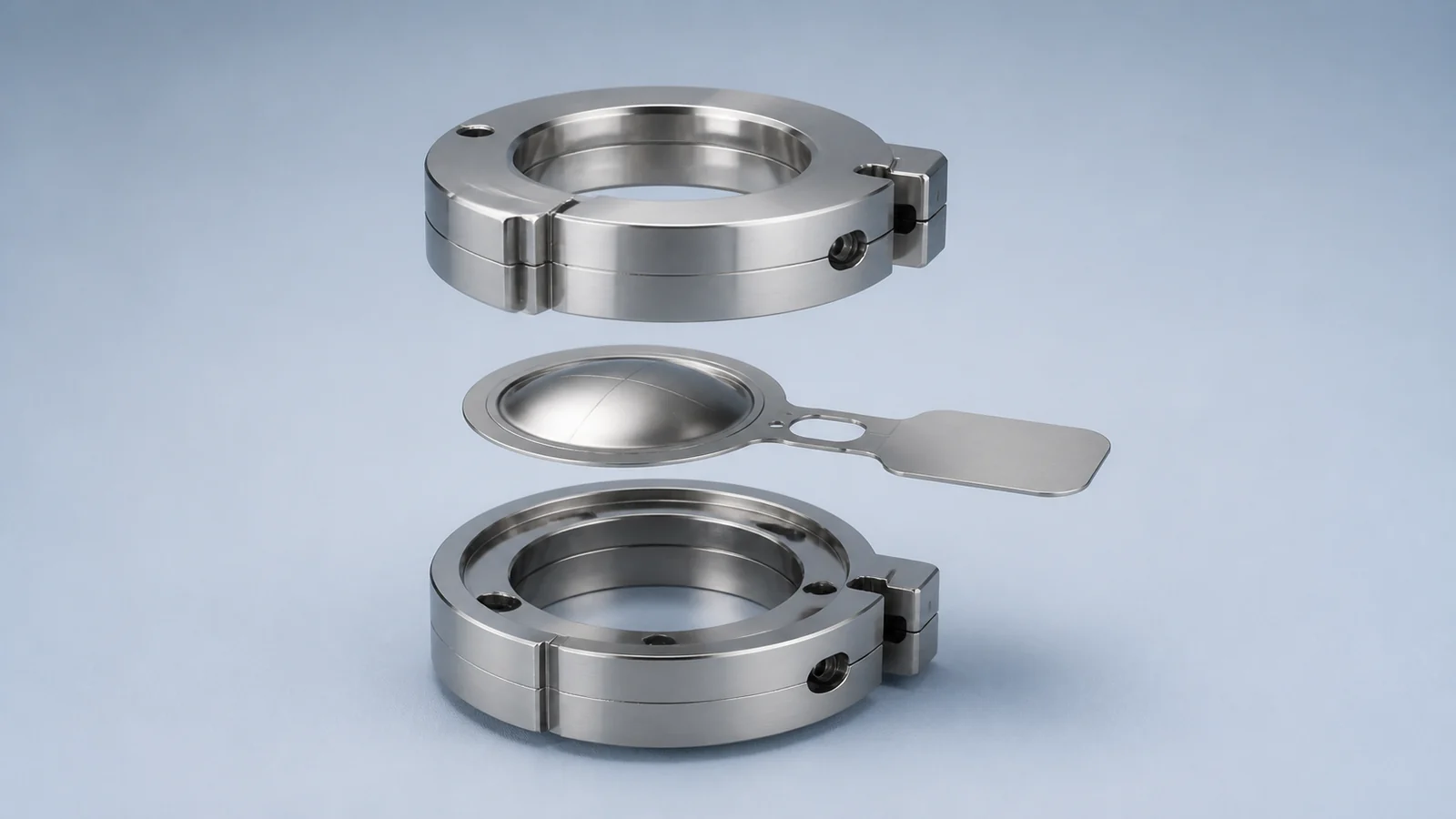
Rupture disc definition
The rupture disc is the pressure-containing element within a rupture-disc device. In many installations it is clamped in a dedicated holder between flanges. Some specialist devices use other mounting arrangements.
During normal operation the disc forms a barrier between the process and the discharge side. When differential pressure reaches the specified burst condition, the element opens. It does not reset, so the process must be made safe and the disc replaced after activation.
A correctly selected disc can create a defined relief opening. Its effectiveness still depends on correct sizing, installation and a safe downstream route. It cannot compensate for an obstructed inlet or undersized discharge system.
How a rupture disc works
Opening is a differential-pressure event. Pressure on the vent side, disc temperature and relief-system resistance all matter.
Pressure acts on the disc
Process-side pressure is compared with vent-side pressure. Back pressure, vacuum and interspace pressure can therefore change the load.
The burst condition is reached
The pressure basis is tied to a stated disc temperature and tolerance. Material, cycling and installation influence performance.
The opening feature activates
A forward-acting element opens under tensile loading; a reverse-acting dome first reverses. Opening behaviour is product-specific.
The system carries the flow
The inlet, holder, flow area, downstream pipework, back pressure and discharge destination must allow the required capacity.
The parts of a rupture-disc device
Pressure-sensitive element
Manufactured for an agreed size, material, burst condition and temperature. It may be metallic, composite, graphite or specially engineered.
Holder or mounting assembly
The holder clamps and locates the element. Seat geometry, size, flow direction and compatibility must be verified as a combination.
Identification tag
The tag supports identification and correct orientation. Compare it with purchase records and current instructions rather than appearance.
Optional burst indication
An indicator can signal when the disc opens. Combined devices may also need monitoring that detects leakage or pressure between components.
Rupture-disc terms worth understanding
Specified burst pressure
The requested activation pressure, associated with a specified disc temperature. It is incomplete without tolerance and temperature.
Marked pressure & tolerance
The marked value or range identifies the manufactured rating; tolerance defines the permitted burst range under stated conditions.
Operating ratio
How close normal operating pressure may be to the relevant burst-pressure basis for a particular design and service.
Manufacturing design range
The agreed range within which a lot's marked pressure may fall. Zero manufacturing range does not mean zero burst tolerance.
Minimum net flow area
The calculated area available after opening, allowing for structural features that reduce the opening.
Flow-resistance factor
A certified value used in relevant sizing methods when the opened device is treated as a resistance in the relief path.
Main rupture-disc design categories
Reverse-acting rupture discs
The dome is loaded in compression and reverses before opening. Depending on family, benefits can include high operating ratios, strong cycling capability and vacuum or back-pressure resistance. Application constraints may apply.
Forward-acting rupture discs
The dome is loaded in tension until the material or opening feature activates. These designs cover broad pressure, temperature, size and material requirements; operating ratio and cycling must suit the process.
Hygienic rupture discs
Hygienic designs address product-contact geometry, cleanability, connection and gasket requirements. Include the complete cleaning and sterilisation cycle in the specification.
Graphite and specialist devices
Graphite can suit selected corrosive, temperature or low-pressure duties. Custom and extruder devices address special mounting and process conditions that require detailed review.
Rupture disc or safety valve?
Neither is universally better. Some systems use one device; others use both to obtain complementary functions.
| Consideration | Rupture disc | Safety or pressure-relief valve |
|---|---|---|
| Operation | The pressure-sensitive element opens by rupturing. | A mechanical valve opens at its set condition. |
| After activation | Does not reclose; replacement is required. | Designed to reclose when conditions permit. |
| Moving parts | None in the disc. | Includes moving mechanical parts. |
| Normal-process seal | Can provide an effective isolation barrier when correctly selected. | Seat leakage performance depends on design and condition. |
| Inspection and testing | Managed through traceable manufacture, installation and lifecycle records. | Can be inspected, maintained and set-pressure tested. |
Why combine a rupture disc with a pressure-relief valve?
An upstream disc can keep corrosive, viscous or polymerising media away from valve internals during normal operation and can help limit normal-process leakage. A downstream disc serves different isolation purposes.
- Check pressure between the devices and monitoring provision
- Assess spacing, capacity and certified flow-resistance information
- Confirm disc fragmentation will not impair the valve
- Apply the relevant code and manufacturer guidance
Where rupture discs are used
Chemical processing
Reactors, separators and lines with corrosive, fouling, polymerising or reactive media.
Pharmaceutical, food & beverage
Hygienic vessels and processes with product-contact, cleanability and sterilisation requirements.
Hydrogen and oil & gas
Systems where pressure, cycling, leakage, material selection, back pressure and vent routing require careful assessment.
Pressure vessels
Primary, secondary or combined pressure-relief arrangements defined by the vessel and relief-system design.
Storage tanks
Selected emergency overpressure or vacuum duties within a properly designed tank venting system.
Special machinery
Custom assemblies for equipment such as plastics-processing machinery where standard flange mounting is unsuitable.
Questions behind the terminology
For device-specific performance, use the current datasheet and the approved application data.
External references: ISO 4126-2 overview and HSE relief-system guidance.
Is “rupture disk” different from “rupture disc”?
No. “Disk” is the common American spelling and “disc” is common British usage. Product literature and search results use both.
Does a rupture disc open at exactly one pressure?
It is specified and marked with a pressure basis, temperature and tolerance. The allowable burst range—not an isolated headline number—is what engineers need to assess.
How quickly does a rupture disc operate?
It is a fast-acting device, but total system response depends on the pressure event, device, pipework and relief path. A generic response-time claim should not replace system analysis.
Can a rupture disc regulate process pressure?
No. It is not a control device. It creates a relief opening when the specified differential-pressure condition is reached.
Can a rupture disc be used for liquid and gas service?
Many families cover liquid, gas/vapour or both, but not every design suits every phase. State the credible relieving phase and whether two-phase flow is possible.
What happens after a rupture disc opens?
The device remains open. Isolate and depressurise the process safely, manage the released medium, investigate the event, inspect the assembly and install a correctly specified replacement.
What can make a rupture disc open too early?
Possible causes include insufficient operating margin, cycling, temperature variation, corrosion, damage, incorrect orientation, holder or gasket problems, uneven tightening, misalignment and unrecognised back pressure.
Who should size and specify a rupture disc?
Competent engineers should define the relief case and required capacity. The supplier and manufacturer can then support device selection using complete application data.
Move from understanding to action
Ask an Assentech specialist
Share your application, existing disc details or pressure-relief question. Assentech can help you identify the information needed for the next technical step.