
Assentech · From specification to service
Breather Valve Lifecycle Support
Protect tank integrity with a planned approach to valve specification, inspection, testing and servicing. Explore each stage to see what Assentech checks, the evidence provided and the value to your operation.
Explore the lifecycle. Select a numbered stage for detailed guidance.
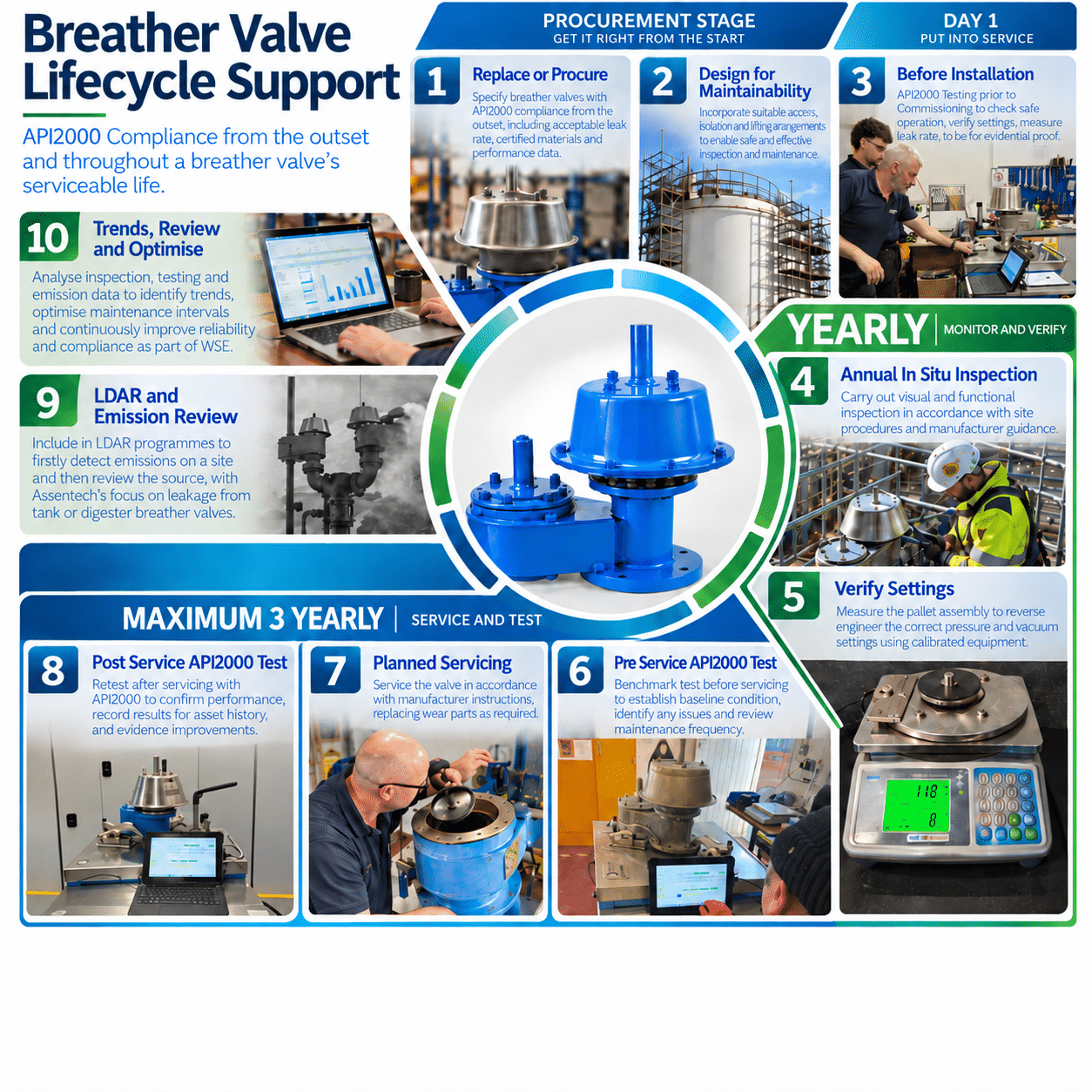
Explore the ten stages
Select a stage to read the checks, records and practical benefits.
1Specification & ProcurementProcurement stage
Why it matters
Correct specification starts before purchase. Review the valve design, installation and operating duty together:
- Valve design: flange type, end-of-line or pipe-away arrangement.
- Accessories: flame arrester, proximity switch, heating jacket or insulation, as required.
- Tank limits: design pressure and vacuum, and required inbreathing and outbreathing capacities.
- Compatibility: stored media, materials and seals.
- Service conditions: operating conditions, environmental requirements and installation arrangements.
Assentech can help you work through these requirements.
Performance verification is essential when considering critical safety equipment to protect your staff, neighbours, facility, environment and reputation. Each valve will be supplied with an individual, traceable API 2000 / ISO 28300 test report, confirming:
- Verification of pressure and vacuum set points against the specified requirements and valve nameplate.
- Measured leakage rates on both pressure and vacuum ports, assessed against the applicable acceptance criteria.
- Verification of pressure and vacuum opening functionality.
- Documented test results, equipment calibration traceability and valve identification.
- Confirmation that the install design will ensure the breather valve can be safely accessed, isolated, removed and replaced throughout its serviceable life.
- Material, asset and certification traceability
The objective is to establish and document correct specification, verified functionality and acceptable leak tightness before the valve enters service.
Value to you
Confidence that the correctly specified valve is purchased from the outset and can be proven.
2Plan for MaintainabilityProcurement Stage
Assess the installation design to ensure the breather valve can be safely accessed, isolated, removed and replaced throughout its serviceable life.
Why it matters
Poor consideration of maintainability during the design and procurement stage can result in unnecessary costs, extended downtime and increased risks to personnel.
Key considerations
- Assetisation: Each device is a critical safety asset that should be allocated with a unique tag number for ageing management and identification.
- Safe access: Ensure adequate access, working space and suitable platforms for personnel undertaking maintenance.
- Isolation arrangements: Provide suitable means of isolation that allow safe valve removal while maintaining adequate tank pressure and vacuum protection.
- Pipework configuration: Review flange specification, flatness, pipework orientation, supports and available clearance to enable straightforward removal and reinstallation.
- Lifting and handling: Consider valve weight, lifting points and access for mechanical handling equipment.
- Swap-in arrangements: Consider installing a correctly specified replacement valve while the original is removed, avoiding unnecessary operational downtime or exposed open flanges.
- Future removal: Ensure surrounding structures and equipment do not obstruct valve removal or require costly modifications.
Value to you
- Clear visibility of asset management requirements across multiple disciplines.
- Reduced maintenance costs and operational disruption.
- Safer, quicker access and valve removal.
- Reduced reliance on specialist access equipment or temporary modifications.
- Minimised tank or digester downtime.
- Faster replacement when unexpected failures occur.
- Avoidance of costly installation modifications later in the asset’s life.
- Compliance with regulatory requirements.
3Pre-commissioning VerificationDay 1: before operation
Why it matters
It’s a chance to review the application as a whole and confirm the valve is correctly specified and selected for its intended location. A new valve is not necessarily functional or leak-tight. Establish its actual as-received condition before the asset enters service. The functionality is confirmed by an API 2000 test.
What this can identify or prevent
- Damage during transit or handling
- Verify manufacturer claim of API 2000 Production Testing
- Packaging or transit materials left inside
- Incorrect assembly or reversed components
- Additional weights or wrong set points
- Damaged diaphragms or seats
- Manufacturing and assembly leak paths
Evidence and records
Traceable baseline API 2000 Vent-Less test certificate and Environmental leak test at 90% of set point with recorded as-received measurements and corrective actions.
Value to you
Check that manufacturer declarations are supported by valve-specific performance evidence before installation. Prevent defects from becoming operational, safety or environmental problems. An opportunity to dispute any issues with the supplier. Potentially an opportunity to use this stage as a payment milestone to release funds to the supplier.
Becomes the baseline of valve performance going forward.
4Annual In-Situ Visual InspectionYearly
Why it matters
Breather valves are exposed to changing process conditions, weather and environmental factors that can cause deterioration over time.
A visual inspection helps identify defects, external interference, damage and signs of wear before they affect the valve’s reliability, sealing integrity or safe operation.
What this can identify or prevent
- Unauthorised interference such as setting changes or theft of weights.
- Fouling, deposits or product build-up that may restrict valve movement.
- Corrosion, physical damage or deteriorating components.
- Blocked screens, vent outlets or drainage points.
- Loose fixings, damaged diaphragms or visible seal deterioration.
- Signs of leakage, including staining, deposits or evidence of escaping vapours.
- Installation damage or external conditions that may restrict operation.
What Assentech does
- Undertake a visual inspection in accordance with the maintenance plan or Written Scheme of Examination, where applicable.
- Review the valve’s identification, location and maintenance history.
- General condition as found
- Evidence of overfill or foam-over
- Setting package weights.
- Examine accessible components for damage, corrosion, contamination and deterioration.
- Check for signs of leakage, obstruction or mechanical defects.
- Record findings and recommend corrective action, servicing or replacement where necessary.
Evidence and records
Documented inspection report, photographic evidence where appropriate, identified defects, recommendations and next inspection due date.
Value to you
- Identify deterioration before it develops into a significant failure.
- Identify unauthorised interference.
- Improve valve reliability and operational safety.
- Prioritise maintenance based on actual condition.
- Reduce the risk of unexpected failures and unplanned downtime.
- Maintain a documented inspection history to support asset management and regulatory requirements.
5Verification of SettingsSix monthly or annually
Why it matters
Correct pressure and vacuum settings are essential to protecting tanks and digesters against excessive pressure or vacuum.
Settings may be incorrect from new or altered through previous maintenance, component replacement or unauthorised adjustments.
Additional weights are sometimes added to valve pallets in the mistaken belief that they will improve sealing, without recognising that they also alter the opening settings and valve capacity.
Verifying the installed configuration helps establish whether the nominal settings remain consistent with the valve specification and tank design requirements.
What this can identify or prevent
- Incorrect pressure or vacuum settings that could compromise tank or digester integrity.
- Additional pallet weights or unauthorised adjustments that alter the intended opening settings.
- Incorrect weights, springs or components fitted during previous maintenance.
- Discrepancies between the installed configuration, valve nameplate and specified settings.
- Valves installed without traceable evidence of original settings verification.
What Assentech does
- Review the valve nameplate, specified pressure and vacuum settings and available test documentation.
- Measure valve pallets and associated weights, using reverse engineering calculations to establish nominal opening settings for suitable weight-loaded designs.
- Where a Vent-Less test bench is available, enter pallet measurements directly into Vent-Less and cross-reference the calculated settings against validated results obtained via the test bench.
- Compare calculated settings against the valve specification and tank or digester design limits.
- Record discrepancies and recommend corrective adjustments or functional testing where necessary.
Evidence and records
Documented pallet measurements, calculated nominal pressure and vacuum settings, comparison with specified settings, relevant Vent-Less validation data and any identified discrepancies.
Value to you
- Identify incorrect or altered settings that could compromise tank or digester protection.
- Detect additional weights and unauthorised modifications.
- Verify nominal settings without necessarily removing the valve for bench testing.
- Reduce unnecessary valve removal, maintenance costs and operational downtime.
- Provide documented evidence to support asset integrity and maintenance decisions.
6Pre-Service API 2000 TestMaximum 3-yearly / risk-based
Why it matters
Preserve a benchmark of as-found valve performance before dismantling or servicing.
What this can identify or prevent
- Underlying or hitherto undetected issues.
- An unsafe breather valve operating beyond its serviceable life
- The leak rate accompanied with the SDS media datasheet, dispersion modelling, H code, risk rating provides essential data for risk management of toxic and flammable media for site zone allocation and reviews
- Review of suitable valve maintenance frequency
- Incorrect set points on both vacuum and pressure settings
- Pre-service leakage rate as a metric for evidencing emission reduction
- Maintenance periods unsupported by data
What Assentech does
- Record as-found condition
- Measure pressure and vacuum settings
- Measure leakage on both ports
- Compare to previous certificates
- Use findings to plan service and review inspection frequencies
Evidence and records
Traceable pre-service test certificate showing actual as-found performance.
Value to you
Understand how the valve truly performed before servicing and if any action is required for the next service cycle.
7Planned ServicingMaximum 3-yearly / risk-based
Why it matters
Restore mechanical condition and sealing performance using controlled maintenance.
What this can identify or prevent
- Hardened, damaged or swollen seals
- Product deposits or corrosion on seats
- Worn or incorrectly fitted parts
- Sticking valve pallets
- Recurring defects caused by unsuitable maintenance
- Corrosion or erosion of pallet, weights or stem
- Damaged seat ring
What Assentech does
- Dismantle and inspect under a suitable safe system of work
- Ensure soft goods kits are OEM as built, high quality and compatible with the stored media
- Clean and evaluate components
- Replace worn or defective parts and soft goods
- Reassemble following appropriate OEM procedures
- Set up for post-service verification
- Record advisories, observations and next steps
Evidence and records
Service record, findings, replaced parts and corrective actions, photographs including nameplate and valve condition.
Value to you
Restore reliable operation and protect useful asset life. Reduced downtime and improved efficiency. Proof of best practice servicing and competent asset management.
8Post-Service API 2000 or ISO 28300 TestAfter service / maximum 3-yearly
Why it matters
A reduced leak rate accompanied with the SDS media datasheet, dispersion modelling, H code, risk rating provides proven best practice data for risk management of toxic and flammable media for site zone allocation and reviews
Demonstrates through measured test results that serviced equipment performs as required before being returned to duty.
Provides evidence of emissions reduction by comparing measured leak rates from pre-service and post-service API 2000 testing.
Demonstrates responsible management of ageing plant and a commitment to protecting the workforce, environment and facility.
Enables service intervals to be reviewed and optimised based on measured performance, supporting long-term reliability and emissions control.
What this can identify or prevent
- Breather valves not fit for service or at the end of their serviceable life
- Assembly errors after servicing
- Altered or incorrect settings
- Seals that do not seat correctly
- Lifespan prediction
- Unacceptable leakage after replacement parts
- Return to duty without objective evidence
What Assentech does
- Accurate, evidence-based API 2000 test data that withstands scrutiny
- Improved performance, functionality and/or sealing
- Test pressure and vacuum function
- Verify both set points
- Measure leakage at both ports
- Apply defined acceptance criteria
- Conduct the additional 90% environmental test where specified
- Resolve failures and issue as-left documentation
- Environmental test at 90% of set point
Evidence and records
Post-service Vent-Less API 2000 test certificate, including settings, measured leakage and pass/fail conclusions. Photographs. Test data generated by a recognised BAT. Traceable test data including technician, test equipment and asset ID. Access to historical year on year test data. Full maintenance cycle expertise.
Value to you
Prove the service outcome rather than just recording the work including a return on investment through reduced emissions. Evidence of comprehensive maintenance steps and data for informed decisions.
9LDAR & Emissions ReviewYearly / risk-based
Why it matters
Detect emissions, investigate their source and prioritise appropriate corrective actions.
What this can identify or prevent
- Unrecognised methane, VOC or toxic vapour releases
- Neighbouring community odour concerns
- Worker inhalation or flammable-atmosphere risks
- Unquantified tank and digester losses
- Poor records of findings and repairs
What Assentech does
- Review LDAR results across tanks, digesters and valves
- Distinguish valve leakage from other sources
- Quantify valve leakage where suitable test data are available
- Review relevant substance hazards and environmental considerations
- Prioritise, complete and verify corrective measures
Evidence and records
LDAR inventory, investigation findings, test results where relevant and close-out records.
Value to you
Turn leak detection into demonstrable emissions management.
10Trends, Review & ReplaceLifecycle review / Written Scheme of Examination
Why it matters
Assess the performance of each asset across service cycles so inspection, servicing and replacement are evidence-led.
What this can identify or prevent
- Repeated servicing of an unsuitable valve
- Year on year deterioration providing a prediction for replacement assets
- Gradually rising leakage rates
- Repeat offenders
- Intervals based only on elapsed time
- Missing asset history
- Equipment past its economic or practical service life
What Assentech does
- Compare historical as-found and as-left test results
- Review leakage trends, failures, costs and condition
- Consider media, duty and process changes
- Update the Written Scheme of Examination and risk-based frequencies
- Recommend continued service, overhaul or replacement
Evidence and records
Consolidated valve history, QR-linked certificates, trend assessment and documented decisions.
Value to you
Use lifecycle performance to justify maintenance and replacement.
Plan the right inspection and service intervals
Inspection, testing and servicing are different activities: visual inspection assesses visible condition; testing verifies functional settings and measured leakage; servicing restores condition and should be followed by suitable verification. Frequencies and acceptance criteria must be aligned to equipment duty, applicable standards, manufacturer guidance and the risk-based maintenance strategy. The 90% environmental test is an additional specified test, not a blanket requirement for every valve.
The intervals shown describe the lifecycle programme; they are not universal statutory intervals. Apply any Written Scheme of Examination where required for the system.
Need support with your breather valve lifecycle?